Wednesday, February 22, 2012

Syrian Violence Increases, Iraq Violence decreases

Sahar Issa, at McClatchy Newspaper's Baghdad bureau, writes that according to the Iraqi government, terrorist related violence in Iraq has sharply decreased over the past few months, especially in the northern province of Ninewah, which has a long border with Syria.  This is widely attributed to a migration of al-Qaeda-esque foot soldiers to Syria, where Assad's army has been facing battles with armed fighters since the early summer of 2011.  The prominence of al-Qaeda style attacks within Syria has grown greatly in recent months, with car bombings in Syria's two largest cities, first on the morning of December 23rd, when two cars exploded outside of government security buildings in Damascus, killing 40, then on February 10th, when an Aleppo police station was hit by another two car bombs, killing 28.  Only two days after the Aleppo attacks, Ayman al-Zawahiri, the head of al-Qaeda, released a video calling for Muslim's across the region to go fight against the Assad regime.    
     In northwest Iraq and its capital of Mosul, the result of this is a new found freedom from terrorist bombings.  Only last year Mosul, the second largest city in Iraq, was home to as many as 800 al-Qaeda fighters, according to US government officials.  A Ninewah-based Iraqi officer interviewed by McClatchy claims that now "Violence is down in Mosul, maybe one or two operations per day, sometimes none," and that in the rest of the province  "violence is down more than 50 percent since autumn of 2011, and much more than that if compared with an earlier date, like autumn of 2010."  

Read more here: http://www.mcclatchydc.com/2012/02/20/139408/iraq-officials-violence-drops.html#storylink=cpy

Read more here: http://www.mcclatchydc.com/2012/02/20/139408/iraq-officials-violence-drops.html#storylink=cpy

iraqadmindiv3.jpg

Monday, February 20, 2012

Interview with Sharmine Narwani

The Real News Network held a very informative interview with Sharmine Narwani, a senior associate at Oxford's St. Antony's College.  Narwani visited Damascus in early January, and gives her views on both her trip and the Syrian situation in general.


More at The Real News


Wednesday, February 15, 2012

Who's making State Department policy

Helpful Articles:
The Consequentialist: How the Arab Spring remade Obama's foreign policy - Ryan Lizza, The New Yorker, 5/2/11
How Obama turned on a dime towards war - Josh Rogin, Foreign Policy: The Cable, 3/18/11

Recently, i have begun to do a little bit of research into who is actually crafting the Obama administrations foreign policy.  As an explanation, i will refer to my original title--"Is the State Department full of Neocons?--because that seemed to be the hypothesis that first jumped out at me.  However, upon digging a little deeper, the answer is murky.   At first glance, none of the prominent "neocon" officials who were instrumental in crafting post 9/11 foreign policy are serving in the Obama administration.  Men like Paul Wolfowitz are Elliot Abrams are ensconced in various think-tanks, while others have entered private business.  However, a good number of their appointees are still holding posts.
          One thing that becomes clear upon looking at the State Department leadership page is that there has been a large amount of turnover in 2011.  The post of Deputy Secretary of State, second in command at Foggy Bottom, was held by James B. Stienberg from the time of Obama's appointment through June 24th, 2011.  Stienberg had worked in the NSC leadership during the Clinton Administration, and worked at the Brookings Institute and the LBJ school during the Bush years.
         When Stienberg left, his post was filled by William J. Burns, a career diplomat who progressed up the State Department ranks under Bush.  He served as head of Near Eastern Affairs from 2001-2005, ostensibly in charge of all Middle East Policy, after which he was made ambassador to Russia--the specialty of then Secretary of State Condeleeza Rice.  In the last year of the Bush administration he was promoted again, to undersecretary for political affairs, 3rd in command at the Department.  He maintained this post through the first three years of the Obama Administration, until his latest promotion last summer.
         Burn's post as Undersecretary for Political Affairs was filled in turn by Wendy Sherman, like Stienberg a veteran of the Clinton Administration who did not serve in government during the Bush years.  Sherman was a founding partner of Albright associates, a private consulting firm, where she most recently served as Vice Chair from 2008-2011.  She was also an advisor to the 2008 Clinton Campaign, as well as serving on Obama's State Department transition team.    

      In the bureau of Near-Eastern Affairs, Jeffrey Feltman has served as the Assistant Secretary for the entirety of the Obama presidency.  Like Burns, Feltman progressed up the ranks of the State Department during the Bush administration.  He worked in the State Department's Jerusalem Bureau from 2001-2003, then with Coalition Provisional Authority in Iraq, heading its Irbil office in the north of the country.  In 2005, he was made Ambassador to Lebanon, where he served until February of 2008, when he was moved back to Washington DC to be the PDAS of NEA, then promoted to acting Assistant Secretary in December 2008.  He maintained this post under the Obama administration.  Within Near Eastern Affairs, a number of Ambassadors were also holdovers from Bush's State Department.
         In Iraq, James F. Jeffrey sits in the massive US Embassy in the Green Zone.  He had done extensive work in Iraq following the 2003 invasion, as well as serving in Ankara as the Ambassador in Turkey from 2008-2010.  Between these two postings, Jeffrey worked at the Near Eastern Affairs bureau, as the PDAS, where he worked with Elizabeth Cheney on Iran policy.  In this position, Jeffrey was heavily involved in the Iran Syria Policy and Operations Group, a controversial office led by Cheney and Elliot Abrams that was accused of pushing for regime change in Iran and Syria.
        In Syria, Robert Ford was finally approved to to the post in Damascus in January 2011.    He had served as ambassador to Bahrain from 2001-2004, and then moved to Baghdad's Green Zone, as a political counselor from 2004-2006 working under John Negroponte, then as deputy chief of mission in 2008-2009.  Between his two postings in Iraq, he was the ambassador to Algeria.  Michael Chudovsky, an emeritus professor at the University of Ottawa and the founder of the Center for Research on Globalization, has accused Ford of implementing many of the same "death squad" policies in Syria that were witnessed in Iraq, policies that were developed during the Reagan years in the Nicaraguan Civil War by Negroponte, Abrams, and Oliver North, etc..., a scandal known by the general name of Iran-Contra.
        In the Libyan situation, Ambassador Gene Cretz played a very interesting role.  A longtime Foreign Service Officer, he moved around the Middle East during the Bush Administration, first in Eygpt and Syria, before being promoted in 2004 to Deputy Chief of Mission in Tel-Aviv.  In July 2007, President Bush nominated him to be ambassador to Libya.  While Cretz was awaiting Senate Confirmation, he went back to the NEA bureau in Foggy Bottom, where he worked under AS David Welch.  It was during this time, in August 2008, that the "U.S. Libya-Comprehensive Claims Settlement" was signed, restoring full diplomatic ties between Washington and Tripoli by settling  claims against Libya stemming from the Lockerbie bombing at $1.5 billion, as well as claims against the U.S. for two bombing raids in 1986 at $300 million.  Four months after the signing, which allowed for a US embassy in Tripoli, Cretz was approved as Ambassador by the Senate.  At the same time, Welch resigned as AS and became a senior executive at the engineering goliath Bechtel, heading the Middle East and Africa divisions.
         Moving forward to 2011, Ambassador Cretz was recalled back to Washington in January, ostensibly being labeled the first "bureaucratic casualty" of the Wikileaks State Department cable dump.  At the time, much hoopla was made in the press about cables Cretz had authored remarking on Gadhaffi's "voluptous Ukrania nurse" and other health details and eccentricites, and it was even thought that Cretz, a career diplomat and the first full ambassador to Libya in 38 years, may lose his job.  However, taking into consideration further events, it could be suspected the Cretz's trip to Washington were for other reasons, as the Libyan embassy was closed in February.  Cretz, kept his job, and returned to the country for the reopening of the US embassy in Tripoli in September 2011, three weeks after rebel forces took Tripoli. In his speech at the openings, he made reference to oil as the "jewel in the crown" of Libyan resources and getting "American companies here on a fairly big scale, which we will try to do everything we can to do that, then this will redound to improve the situation in the United States with respect to our own jobs." However, in January 2012, it was announced that Cretz was being replaced by Chris Stevens, who had served as the State Department envoy to the Benghazi forces starting in April 2011.


More coming tomorrow...

Sunday, February 12, 2012

Links for 2/12/11


Former CIA officer questions EU motives in Syria - EUobserver.com, 6/23/11
          This piece relays the opinion of Robert Baer, a former CIA operative stationed in Syria turned author and pundit, who sees the Syria situation as one of regional political warfare, with the Arab Gulf states, Israel, and Turkey pitted against Iran, Syria, and the Hezbollah faction in Lebanon.
"We've taken sides in the Middle East. We've taken sides with Israel and with the Sunnis, from the US to the Dutch and the French. It's part of our cultural and historical background," he said.
Baer added that France, the former colonial power in Lebanon and Syria, is mainly interested in protecting its old friends, the Maronite Christians in Lebanon: "They don't want to see the roof blown off Lebanon because they still feel responsible for the Maronites. They are tightly wrapped up in Lebanon."
He noted that Turkey is also trying to weaken the Shia alliance in order to become the pre-eminent power in the region. "I'm still talking to my Syrian contacts and they are quite convinced that weapons are coming in [to the opposition] not just from the Sunnis in Lebanon and through Iraq but also from Turkey."
The EUobserver article also adds reporting from an unnamed EU diplomat in Brussels, who stated, "We have reports that Wahhabists [radical Sunni Islamists], who are not necessarily controlled by any state, are coming into Syria from Iraq and from Saudi Arabia to create chaos. Inside Syria, there are snipers shooting at demonstrators who are not controlled by Assad but by the deep state, and other snipers who are shooting at both demonstrators and police."

Saturday, February 11, 2012

Syrian Population Numbers

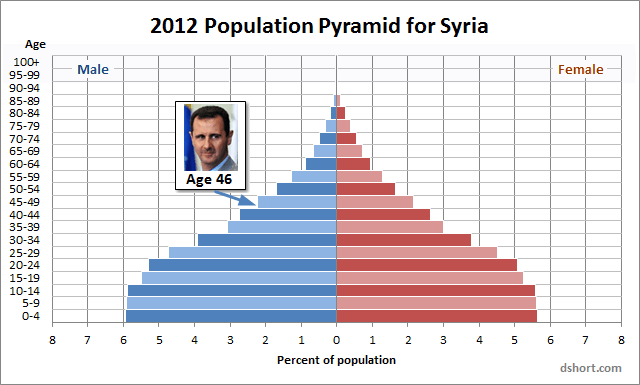
Found these two charts today in the archives of Syria Comment, the excellent blog run by Dr. Joshua Landis.  The first is the Syrian population graphed according to age and gender.  The second is a breakdown of populations figures in Syrian cities based on a 2008  national census.  Keep in mind that the million plus refugees living in Syria are probably not counted in these figures:


Governate
Population* ( in millions)
Damscus (City)1.648
Damscus (Subrubs)1.711
Aleppo5.315
Homs1.977
Hama1.938
Latakia1.161
Deir ElZor1.511
Hasaka1.445
Raquah0.903
Swaydaa0.46
Daraa1.011
Tartous1.011
Qunaytira0.904
Tartous0.446
Idlib1.865
Total23.306


Population Under 15 years of age**
40%
Population over 65 years of Age**3.30%
Popoulation between 15 & 65**56.70%
*(2008) National census Office
** (2004)National census Office

Friday, February 10, 2012

Syria Links for 2/10/12

A review of Assad's first term in in office - Ehsani, Syria Comment, 5/18/07
NATO ships drop anchor in Tunisia - Tunisialive, 2/10/12

Militarizing the Conflict

        Earlier this year, London's Daily Telegraph newspaper reported on plans being developed within the U.S. State and Defense Departments to militarily intervene in Syria, independent of the UN, through a "Friends of Syria" coalition. They state that an unnamed State Department official has revealed "the debate in Washington has shifted away from diplomacy and towards more robust action," and that Central Command "has begun a preliminary internal review of US military capabilities in the region." They quote the same official as saying: "The decision-makers have not determined we are at a point of no return...There is still a window, it is just that that window is closing...We definitely don’t want to militarise the situation. If it’s avoidable we are going to avoid it. But increasingly it looks like it may not be avoidable."  This bureaucratic move towards militarization had also taken place in London, where it was reported that the Ministry of Defense and National Security Council were making plans for a NATO sponsored "No Fly Zone" over Syria.


       This reporting is the latest and most in depth on the Obama administrations contingency plans for regime change in Syria, a scenario that has been on the White House docket since last April.  On the 29th of the month, Obama issued an executive order  leveling personal sanctions against three prominent Syrian officials, one of whom was the brother of President Assad. Concerning the Syrian leader, an unnamed White House Official stated at the time "Don’t think for a second Bashar is not on our radar, and that if these abuses continue we won’t sanction him."
         Obama's bellicosity was backed up by a gaggle of prominent Senate hawks, most notably Joe Lieberman, John McCain, and Lindsey Graham.  One day prior to the White House sanctions announcement, the three Senators released a joint statement, calling on the President to "take tangible diplomatic and economic measures to isolate and pressure the Assad regime, including through targeted sanctions against Assad himself and other regime officials who are responsible for gross human rights abuses." While their statement also asked Obama to call for Assad to step down, it was clear that the Obama administration and the Senate hawks were close to lockstep in their thinking on Syria.  Reporting on this new Syrian policy was Josh Rogin at Foreign Policy's blog, The Cable. He wrote that in the past two weeks a White House "mood shift" on Syria had occurred, with President Assad no longer being seen as likely to reform. Then, "after a series of deliberations, culminating in a Deputies Committee meeting at the National Security Council last week, a new policy course was set."


           This new policy course revealed itself as summer began.  In mid-May, another round of economic sanctions was leveled against top Syrian officials, this time including President Assad, as well as six of his top aides.  Just as before, Obama's Congressional flank was protected by the Senate hawks, led by Marco Rubio, a republican Senator from Florida and a members of the Senate Foreign Relations Committee.  One week prior to the second round of sanctions, Rubio sponsored a resolution urging President Obama to issue more sanctions against Syria, this time targeting the very top leadership.  Rubio's resolution was cosponsored by Senators John McCain, Joe Lieberman, and Ben Cardin.  Internationally, the White House policy was buttressed by the European Union, which also issued sanctions against the Syrian government.  At the same time, the rhetorical pressure against the Assad regime began to reflect this new policy, with Obama stating in a speech on May 17th that the Syrian people have demanded a transition to democracy, and Assad was faced with a choice, to "lead that transition, or get out of the way."  Speaking to reporters at the State Department, Secretary of State Clinton added that: "Every day that goes by, the position of the government becomes less tenable and the demands of the Syrian people for change only grow stronger."  
        As the summer heated up, so did Washington's designs for Damascus.  In June, reports began to come out that the Syrian army and populous were facing a battle with foreign fighters.  An unnamed EU diplomat told the EUObserver that, "we have reports that Wahhabists [radical Sunni Islamists], who are not necessarily controlled by any state, are coming into Syria from Iraq and from Saudi Arabia to create chaos. Inside Syria, there are snipers shooting at demonstrators who are not controlled by Assad but by the deep state, and other snipers who are shooting at both demonstrators and police."  There was also a claim, made months later, that beginning in April-May 2011, the NATO airbase at Incirlik, Turkey was being used as an arms-smuggling hub for Syrian opposition fighters, run by a defected Syrian army colonel, Riad al-Assad.  This story was broken by FBI whistleblower-turned activist Sibel Edmonds, who is a native of Turkey.  While her reporting was not picked up by the mainstream U.S. press, she quotes her high-level source as to why "Who said we didn’t go to [Mainstream Media] first? We got them the info back in October. First they were interested and drooling. At least the reporters. Then, they disappeared. We sat and waited for a few weeks, and no one followed up. It is Turkey. It is NATO. It is our CIA guys. The media hot shots would not touch those cases without State Department sanction attached."
        By early July, the State Department was openly courting the Syrian opposition, with Ambassador Robert Ford taking a much publicized visit, accompanied by the French Ambassador, to meet anti-government protesters in Hama on July 7th.  A great deal of tension resulted from this visit, as it triggered a pro-Assad demonstration at the American and French embassies in Damascus, where windows were broken, flags torn down. and walls besmirched with graffiti.  Back in Washington, Secretary of State Clinton upped the ante once again, telling reporters "President Assad is not indispensable, and we have absolutely nothing invested in him remaining in power."  For his part, Ambassador Ford relayed his thoughts on the ordeal through a Facebook post (perhaps to posture himself as a protester and not a government man) where he wrote "And how ironic that the Syrian government lets an anti-U.S. demonstration proceed freely while their security thugs beat down olive branch-carrying peaceful protesters elsewhere."  By early August, Secretary of State Clinton was holding official meetings in Washington D.C. with Syrian opposition figures.  Herbert London, the president of the Hudson Institute, characterized the State Department as "betraying" the pro-Democracy forces within the opposition, writing: "Most of those invited, however, have links to the Muslim Brotherhood. Missing from the invitations are Kurdish leaders, Sunni liberals, Assyrians and Christian spokesmen. According to various reports the State Department made a deal with Turkey and Muslim Brotherhood representatives either to share power with Assad to stabilize the government, or replace him if this effort fails."
         
        Then, on August 18th, Obama and his NATO compatriots in London, Paris, and Berlin stated their desires bluntly, that Assad must step down. "For the sake of the Syrian people, the time has come for President Assad to step aside," read a White House press release.  Washington backed up its rhetoric by issuing yet another round of economic sanctions against Syria, this time very broad dictates that seized all Syrian assets under U.S. jurisdiction, banned imports of Syrian oil, and banned any contact by American citizens with the Syrian government.  Similar sanctions were also adopted the European Union.  The New York Times described this bout of hard-edged diplomacy as the culmination of a months long debate, one that moved the administration "from discussing whether to call for Mr. Assad’s ouster to discussing how to help bring it about, and what to do after that." In short, it had become U.S. policy to destabilize the Syrian government.
          It is at this juncture that the Obama administration crossed the rubicon on the Syria situation.  How long could it allow Assad to continue sitting in Damascus without committing military might to the problem?  How strong were the words of the NATO alliance without the firepower of their fighter-squadrons and special forces?  "Saving Face" has a long tradition in American politics, and it takes a very strong leader, perhaps stronger than Obama, to go back on his word and allow Assad to stay in power, if that is how the situation in Damascus resolves.  While Obama may give his new policy of destabilization time to play out, what would his deadline be before he turns to his National Security Advisor and says "protocol and law be damned, lets go get this guy?"  If it is September 2012, and the President is facing an immanent election, can he withstand criticism that he went back on his word and "abandoned the people of Syria?"  Being more bellicose than the Democrats has been a plank of the GOP for the past decade, and due to the Obama administrations war-happy nature, Syria could be the only talking point where a Republican candidate could really hammer down on the "dovish" president.  It appears that by calling for Assad's ouster, the Obama administration backed itself into a corner, with the only way out being to machine the fall of the Syrian government through one means or another.


          Throughout the fall of 2011, groundwork was laid for the new policy of "helping to bring about" the fall of the Assad government.  A semi-respectable opposition group was established, the Syrian National Council, led by a Paris based exile, as well as an opposition militia, the Free Syrian Army.  These group are established as much for their public-relations worth as their diplomatic value.  Press, especially those relying on second-hand reports, need a good and evil dichotomy to report on, a brigade of "freedom fighters" to support against the brutal government thugs, and an "opposition leader" to quote on the political sanctity of whoever would replace Assad.
         By the end of November, it was time to kick the policy into action.  Reports began to filter out that NATO governments had set up three training camps for Syrian opposition fighters, one in Turkey, one in Jordan, and one in the Lebanese town of Tripoli.  The Turkish camp was located in the coastal town of Iskenderun, in Turkey's Hatay province, less than 60 miles from Aleppo, Syria's largest city.  The Jordanian camp was located in the town al-Mafraq, seven miles from the Syrian border.  Reports indicated that when U.S. troops were departing en masse from Iraq, some planes went to Jordan, where they set up at the al-Mafraq airbase, long a center for Jordanian plots against their northern neighbor.  Additionally, 600 Libyan fighters fresh from their march on Tripoli were sent to Turkey, commanded by former al-Qaeda leader turned Libyan rebel commando Abdulhakim Belhadj.  This came on top of reports from Milliyet, the Turkish daily, that France, Britain, and Turkey "had reached an agreement to send arms into Syria," and that the U.S. had been notified of the decision.
          Concerning the halls of Washington D.C., Philip Giraldi, a former CIA officer turned journalist, revealed in early December that two new "intelligence findings" had been signed in the White House, authorizing stepped up covert action against Damascus and Tehran.  Later that month, Foreign Policy magazine described a NSC working group designed to aid the Syrian opposition that was put into action, led by NSC senior direction Steve Simon and State Department official Frederic C. Hof.  Then as 2012 began, out come the two reports mentioned at the beginning of this article, indicating that plans to "militarize" the situation were being put into place in the State and Defense Departments and their London counterparts.


          Where does this leave the Obama administration?  While rhetorically threatening a military intervention is one thing, implementing one is far different, without even considering the sphere of the UN and international law, where Assad seems to have the backing of Russia and China.  Perhaps Obama is content to keep sponsoring a proxy war of destabilization through Syria's neighbors, although this does not seem to be effective in bringing down Assad.  As discussed earlier, it would be very difficult for Obama to go back on his word and allow Assad to remain in power, especially now that the bureaucratic structures of the National Security State have been streamlined for destabilization.  
           It appears that Syria has become a crucial fulcrum for the White House, with the tantalizing option of overt military intervention on one side, and a continuation of diplomacy and covert action on the other.  But as Obama is trying to stay balanced in the middle, he seems to be slipping closer towards militarization with every day that Assad remains in power.  Will he sacrifice America's strategic interest in staying out of another Middle East War for his own political gain?  Or will he fall on the realist sword and leave the Assad government in place, perhaps in the process giving up his own shot at a second term in the White House.