Showing posts with label al Jazeera. Show all posts

Wednesday, March 28, 2012

al-Jazeera follow-up

Today, the Lebanese newspaper al-Akhbar, which has been on the forefront of Middle East media criticism regarding the "Arab Spring," published details into al-Jazeera's editorial position on Syria.
They focus on the period from November 2011, when a significant shakeup occurred at the top of the Doha based editorial board, through today.
When the former director general Wadah Khanfar left in September 2011, the channel’s administration changed.  The Egyptian-born Ibrahim Helal was then appointed as head of news.  He replaced an Algerian, Moustafa Sawwaq, who was appointed as director general of the Arabic channel.  Another Algerian, Mohammad Safi, was appointed as director of input instead of the Jordanian Mohammad Daoud. Abdul Haq Saddah, also from Algeria, was appointed as head of planning.  These changes came as a result of an internal settlement of accounts. Thus begins the era of the hawks in the Qatari news channel.
They write that Helal originally attempted to reform al-Jazeera's coverage of Syria, which he viewed as "unprofessional" and too heavily focused on opposition-provided casualty counts, which Helal did not trust:
The killing of French journalist Gilles Jacquier in Homs on 11 January 2012 led to Helal losing his composure. Rather than highlighting Jacquier’s death, the editorial department focused on the numbers of Syrians killed and exaggerated the number. Helal thought this was purely sensational.  He sent out a letter entitled “The Killing of the French Journalist” on 12 January 2012. It was highly critical of the “obsession” and “celebration” of “the death toll.” He stressed the sanctity of Al Jazeera’s slogan and insisted on “not adopting a position just to appease viewers.”
Helal's attempts at reform, however, failed to take hold, as the al-Akhbar article states "senior employees admit in their private circles that no one who works for the channel can express opinions on Syria contrary to those of the Qatari emir. Otherwise, they will be ostracized and humiliated until they leave."  This seems to be the case of Ali Hashem, the al-Jazeera Beirut correspondent who resigned earlier this year over the channels editorial dictates on Syria.

Monday, March 19, 2012

"The Lebanonization of Syria: New Observer Delegation Report

Source: University of Texas
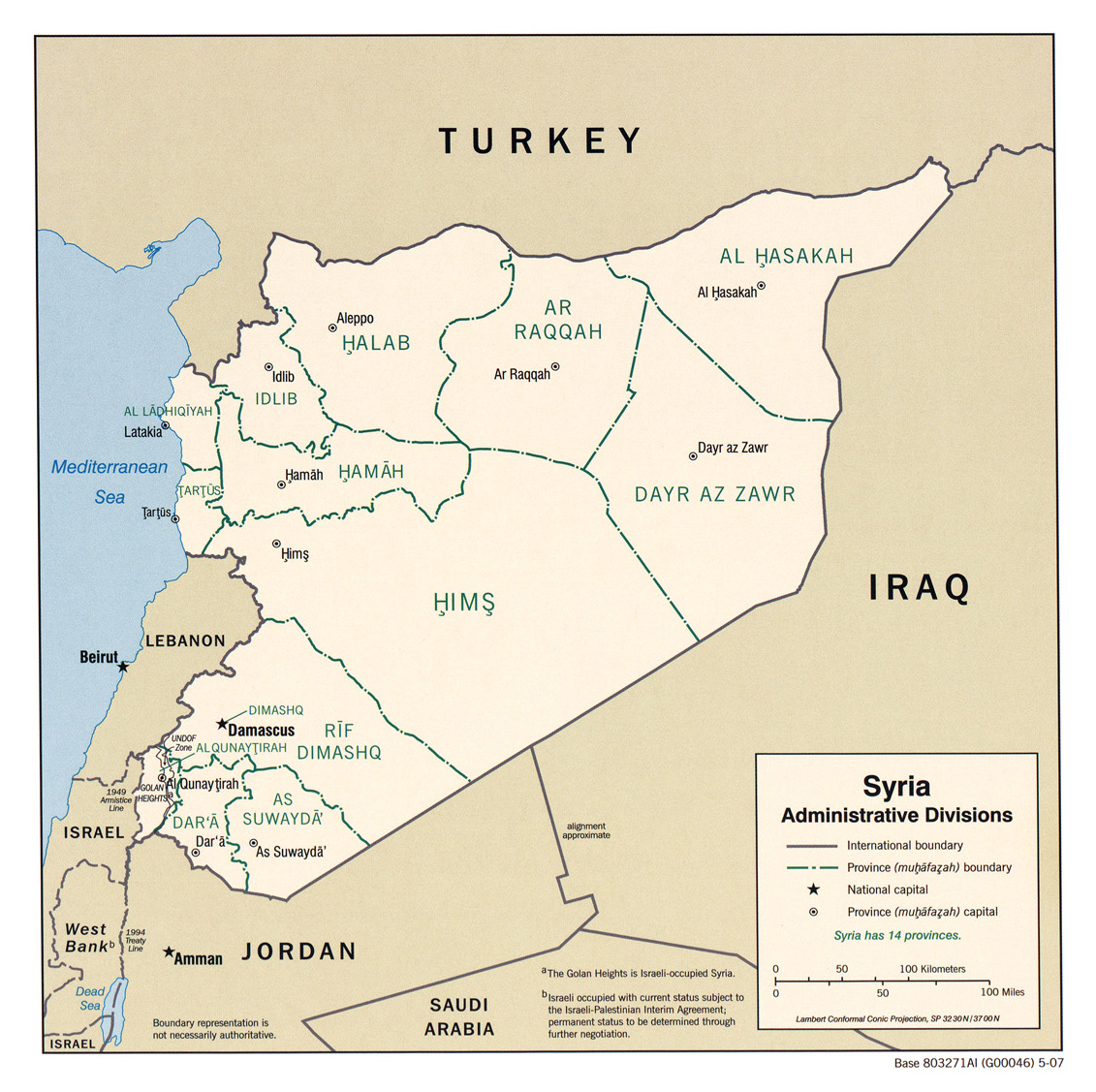
Today a new report on Syria came to my attention (h/t Syria Comment), published in January 2012 report by the "French Centre for Intelligence Research (CF2R)" and the "International Centre for Research and Study on Terrorism and Victims of Terrorism (CIRET-AVT)."  These groups sent a delegation of four experts to Syria between 12/3/11 and 12/10/11, to interview leader on the ground and gather evidence.  Of note, their mission ended when the Arab League Observer Mission began.
     Their 55 pg. report, titled "The Lebanonization of Syria," portrays a state that is cracking apart along social and religious fault lines, to the dismay of a majority of the Syrian population that desires stability above all else.  The report gives a good timeline of the 2011 uprising, detailing both the actions of the government security forces and the armed opposition, as well as the protest centers in Homs and Deraa.  Their thesis is that violence by both sides is working in sync to radicalize the crisis.  When the Syrian security forces were overly brutal at the beginning of the protests in March 2011, it sent the opposition to arms, and then then when Assad backed off, it only encouraged opposition fighters to become more violent.  The report states that as early as March 18, three days after protests began:
Military weapons were spotted not only in Deraa, but also in Homs, Hama and in different towns near the Turkish border.  However, for three months, demonstrations were mostly peaceful...after several weeks of revolt and repressions, many peaceful demonstrators were arrested, leaving the streets to the more radical elements.  The population then observed the appearance of armed demonstraots with support from abroad...As of June 2011, the movement began to radicalize in most of the centers of protest and the activists began to demand the resignation of Bachar al-Assad and the end of the regime. According to many witness reports from among representatives of the domestic opposition and leaders of the religious communities, after the appearance of these armed activists in the summer of 2011, demonstrations were no longer peaceful and protesters were actively seeking direct confrontation with the security forces and started making use of their military hardware.
     The report also highlights the extensive anti-Assad propaganda being put out by Arab, Gulf-funded media (such as al-Jazeera and al-Arabiya), as well as U.S. and U.K. media, which omits facts on the ground, and in some cases even has faked video evidence.  "The media coverage is overly one-sided and appears to fit the dominant geopolitical agenda, that of the American neoconservatives who have divided the Middle East between 'moderate Arab nations' (Egypt, Jordan and the oil-rich monarchies) and the 'forces of the axis of evil' (Iran, Syria, Hezbollah, and Hamas)," the report states.  In the words of Melkite Patriarch Gregorios III, a Christian leader in Damascus, "the position of the international press and foreign players is to act as if absolutely nothing true or good could come from the Damascus regime, and to make them responsible for every problem.  This has made Syrian public opinion turn against Western countries and their journalists."  Asma Kaftaro, the director of the Sunni Women's Organization, notes that "no international media organization covers the demonstrations against foreign intervention which take place frequently," and that "the harshest criticism of the regime comes from abroad, from the international press, far more than from inside the country."

For much more information, please read the full report below.       The Lebanonization of Syria

Thursday, March 8, 2012

Media Censorship of Competing Narratives in Syria

       This week, two stories have come out of news organizations censoring their employees views on Syria, both in American and Arabic media.
       The first comes from Sharmine Narwani (see her interview on the Real News Network here), a Senior Associate at Oxford's St. Antony's College, and writer for al-Akhbar English and the Huffington Post.  Concerning the Huffington Post, which she is now charging with censorship, Narwani began working there in September 2009, hired by Hanna Ingber, the founding World Editor of the website (and no longer a Huffington Post employee). Narwani wrote articles and commentary on contentious issues like the Palestinian conflict, the War on Terror, and US-Iranian relations, and as she put it, quickly discovered that her "niche at the HuffPost was providing counter-narratives to Washington’s narratives on the region."  Despite these hot button topics, Narwani states that prior to July 2011, all 41 of her long and detailed articles were published by the Huffington Post.